

Data Doubt Cloud of Tesla's Unexpected "Acceleration"
Category:
Company News
Source:
Release time:
2022-11-24
Tesla has been a bit loud lately. The first was a big sale at a reduced price in late October, which caused friends to make a lot of noise, and everyone was at risk; One was a tragic accident in Chaozhou, Guangdong Province, in early November, in which two people were killed and three injured, which caused a heated discussion on the Internet.
Like many previous "ghost brake" and "accidental acceleration" accidents, this time, the owner and Tesla once again have their own words.
The son of the owner said that when his father wanted to brake, he found that the brake pedal was very hard, so he had to step on it and continue to drive forward, and Tesla took out the background data to say that the vehicle's electric door was deeply stepped on for a long time, and once maintained 100%; There was no action of pressing the brakes the whole time; During driving, the driver briefly presses the P gear button four times, and then quickly releases it, while the brake lights also quickly light up and go out.
The owner's testimony and Tesla's driving data are obviously contradictory, and the analysis of the driving data by a third-party testing agency designated by the traffic police department and the determination of accident responsibility seem to have become an objective and fair adjudication method.
However, in the past few years, automobiles are accelerating the evolution from typical mechanical products to digital products that integrate various high-tech digital products such as power and electrical technology, electronic information technology, mobile interconnection technology, and artificial intelligence technology. In the case of intelligent electric vehicles becoming more and more complex, the analysis of accident causes is becoming more and more professional, and the requirements for testing institutions are getting higher and higher.
In fact, many testing institutions only have the ability to detect the mechanical performance of automobiles, and the level is higher, which can interpret some simple driving data, but does not have the ability to detect the software and algorithms of the car. Furthermore, for some accidental and difficult to reproduce systematic failures, even the software developers themselves are difficult to identify the bugs in the software by reproducing the failures.
All this makes Tesla's "accidental acceleration" event more and more confusing.
As of the date of writing (November 22), the third-party testing agency designated by the traffic police department has not given the analysis results of the driving data and the determination of the responsibility for the accident, and the family of the owner has expressed their distrust of the third-party test in advance.
Aside from the subtleties of human nature that seeks benefits and avoids harm, and does not mention the safety risks of the 'single pedal' model itself, it is really difficult for consumers to prove their innocence in the face of Tesla, which controls data and has the right to interpret data.
In this regard, some netizens ridiculed, "In order to prove that there is no mistake in their operation, they can only install a camera at their feet." Indeed, a Tesla owner has already done this, and the owner also said a meaningful sentence: "I trust Tesla very much, but trust is really not worth anything!" ”
The distrust of accident owners and consumers is actually a distrust of the driving data provided by Tesla and the data interpretation ability of third-party testing agencies.
What users want to know more is what kind of information does this driving data contain, and who else has this driving data besides Tesla? Is this data complete enough for this kind of ghost braking, 'accidental acceleration'?
Platform big data
With the development of vehicle electrification, intelligence, networking, and sharing, as well as the deployment of various sensors and electronic systems, the amount of data generated by smart electric vehicles has grown rapidly, and the value hidden behind the data has become increasingly prominent.
For car companies, this data is of immeasurable value. Data mining through big data technology can be used to monitor vehicle operating status, analyze and judge product defects, improve product design, optimize product matrix, and can also exert its marketing value, serve user needs, promote product sales, analyze user behavior, outline user portraits, improve consumer satisfaction, and so on.
Data-driven technology companies such as Tesla that are interested in achieving automatic driving will collect data such as accelerator, brake, steering, and gear for iteration of automatic driving algorithms, and the upgrade of vehicle speed vehicle systems and the improvement of control systems are also inseparable from the support of data. Therefore, the 'P gear', 'brake' and 'throttle' data in this accident are just a drop in the ocean in Tesla's background data, and the weak water is only one of three thousand.
So, how to avoid car companies being athletes and referees? Or, how to avoid car companies tampering with and concealing data? Rest assured, there is a national big data platform to be a fair judge! In 2017, Beijing Institute of Technology built the "National Monitoring and Management Platform for New Energy Vehicles", which can realize the operation safety monitoring and other functions of automobiles.
It is worth mentioning that this big data platform also has a function that makes car companies smell different - financial subsidy accounting. In 2017, when fraud was prevalent, and it was also the year that the platform began to go online, the number of new energy vehicle companies declared and promoted was 230616, and the final number of promotion approved by the expert group was 161667, minus 68,949 vehicles, relying on the support of the national monitoring and management platform.
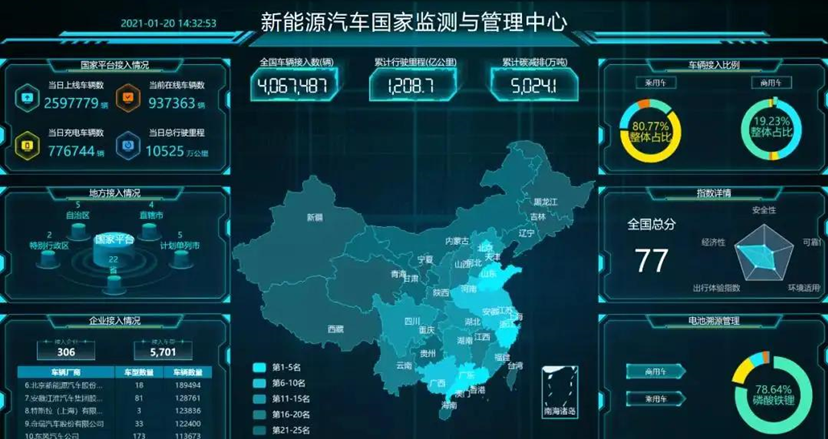
The normal data flow direction is as follows: the bicycle data is transmitted from the vehicle terminal to the enterprise platform, from the enterprise platform to the local government platform (this step can also be omitted), and finally to the national platform.
The data to be transmitted and the data transmission method follow the national standard GB/T 32960 "Technical Specifications for Remote Service and Management System of Electric Vehicles", and the data related to this accident are 'vehicle speed' in the 'vehicle data' (the maximum speed of the accident car reaches 198km/h), 'gear' (four times P gear), 'braking force' (the brakes are not applied throughout the process).
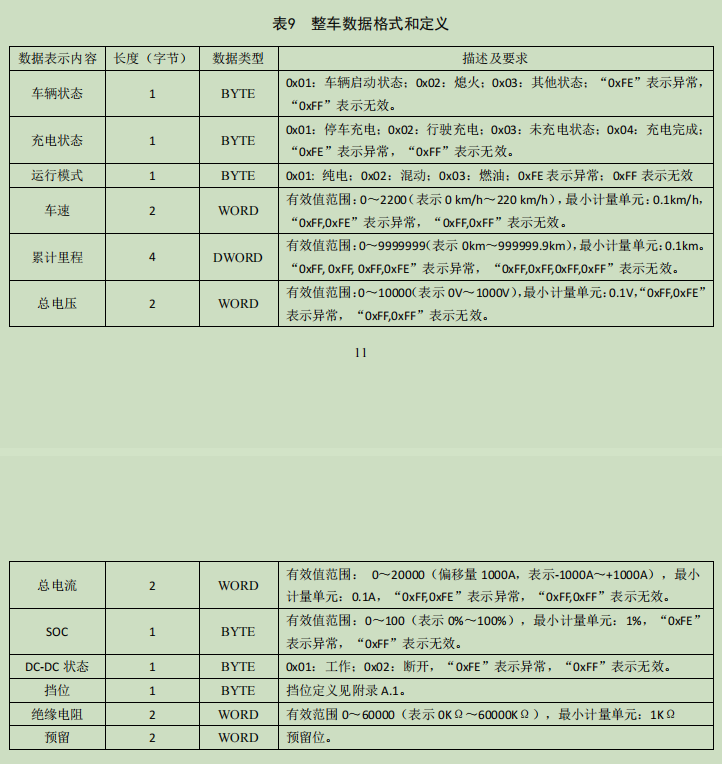
GB/T 32960 vehicle data format
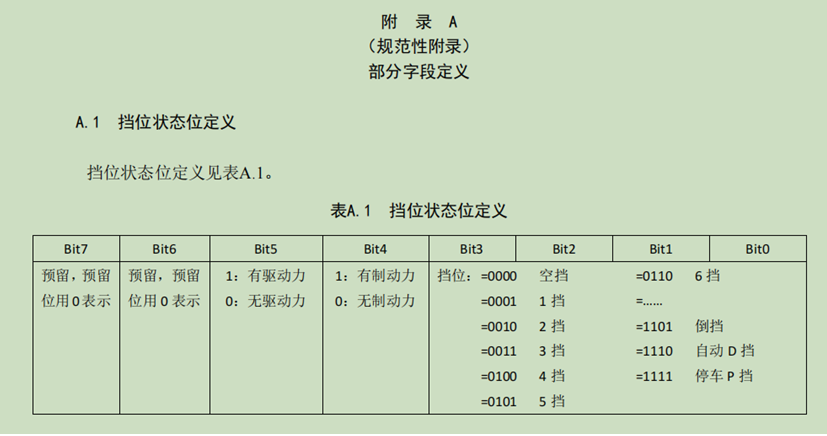
GB/T 32960 gear and braking force data format
Does this mean that Tesla can prove its innocence? Non also!
Because, in terms of determining the cause of the accident, the data of the most credible national regulatory platform is not complete. First of all, whether the 'braking force' in the gear information directly corresponds to whether the driver has pressed the brake pedal is debatable, and secondly, reading through GB/T 32960 shows that there is no "brake pedal status, accelerator pedal travel value" mentioned by some trolls on the national platform.
To calm the debate, Tesla should provide travel data for the brake and gas pedals, which are closely related to the training of self-driving algorithms, and are likely to be available on its enterprise platform.
If for some reason, Tesla can't provide this data, will the much-anticipated EDR (Event Data Recording System) provide it?
Car-side 'small' data
First of all, it is necessary to determine whether the Tesla accident car has an EDR, and secondly, it is necessary to determine which data the EDR provides for which time periods.
Regarding the purpose and time of mandatory installation of EDR in domestic cars, it is necessary to make a clarification.
Item 8.6.6 of GB 7258-2017 "Technical Conditions for the Safety of Motor Vehicle Operation" stipulates that 'passenger cars shall be equipped with an event data recording system (EDR) that can record data information such as vehicle driving speed and braking status when a specific event such as a collision occurs; If it is equipped with an on-board video driving recording device that meets the requirements of the standard, it shall be deemed to meet the requirements. 'Its main purpose is to ensure that in the event of an accident such as a passenger car collision, the management department can accurately confirm the status of the vehicle, analyze the cause of the accident, ensure the fairness and justice of the accident handling work, and maintain social fairness and justice.
However, this clause does not follow most of the provisions from January 1, 2018, and considering the actual situation of domestic passenger car manufacturers, this clause is given a 36-month implementation transition period, that is, from January 1, 2021 for newly produced passenger cars. During this period, due to the fact that the national standards for automobile event data recording systems and on-board video driving recording devices were not issued in time, item 8.6.6 was postponed for another year to January 1, 2022.
According to the information provided by the owner, the Model Y was purchased in November 2021, and it is impossible to confirm whether the car is equipped with EDR from the perspective of the implementation time of the national standard. However, judging from Tesla's confrontation with domestic accident owners in the past two years, Tesla's Model 3 and Model Y are equipped with EDR as standard.
But can EDR provide driving data for a minute or so before the accident? No!
According to GB 39732-2020 "Automobile Event Data Recording System", the condition for triggering EDR storage (recording) data is "vehicle speed change is not less than 8km/h within 150ms", obviously, the high-speed running of the car will not trigger the EDR data recording function, and the initial acceleration will not reach the trigger condition. Because the trigger threshold of EDR is equivalent to accelerating from zero to 100km/h or decelerating from 100km/h to 0 in 1.875 seconds, model y cannot achieve such a 100km/h acceleration capability, and in this accident, EDR data recording can only be triggered by the final collision of the vehicle.
So, how long before the collision is the data required to be stored? As you can see, it's only five seconds!
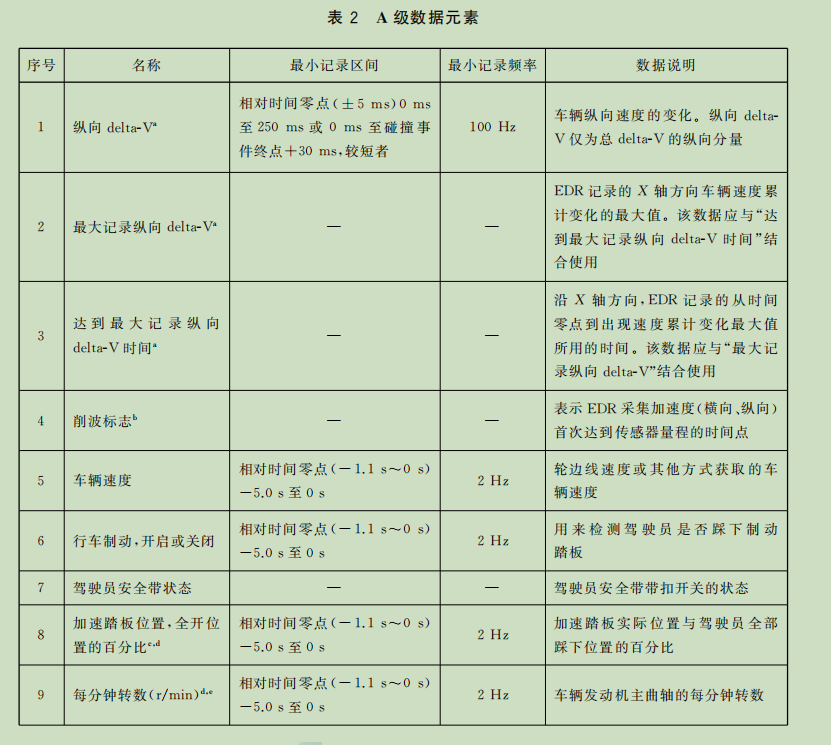
Excerpt from A-level data format
Therefore, it is unrealistic to hope that a third-party testing agency can restore the real situation of one minute of horror after reading the EDR data!
Write at the end
The data items of the national new energy vehicle big data platform are incomplete, the EDR data recording time is not enough, and the only driving data that can give complete projects and complete time is Tesla itself. Going around in circles, it's back to square one!
If you really want to prove your innocence, Tesla can come up with complete data on vehicle speed, acceleration, accelerator pedal opening, and brake pedal travel in the two minutes before the accident, but perhaps this can only become a luxury.
After all, Tesla, which has just gone through a round of price cuts, has begun a second wave of price cuts in order to pull up sales.
Tesla owners don't have to panic too much, if there is any lesson to be learned from this accident, that is, the P gear button must be held for more than three seconds before the vehicle's automatic braking system will start, and if the press time is short, the emergency brake cannot be activated. Remember, remember!
